

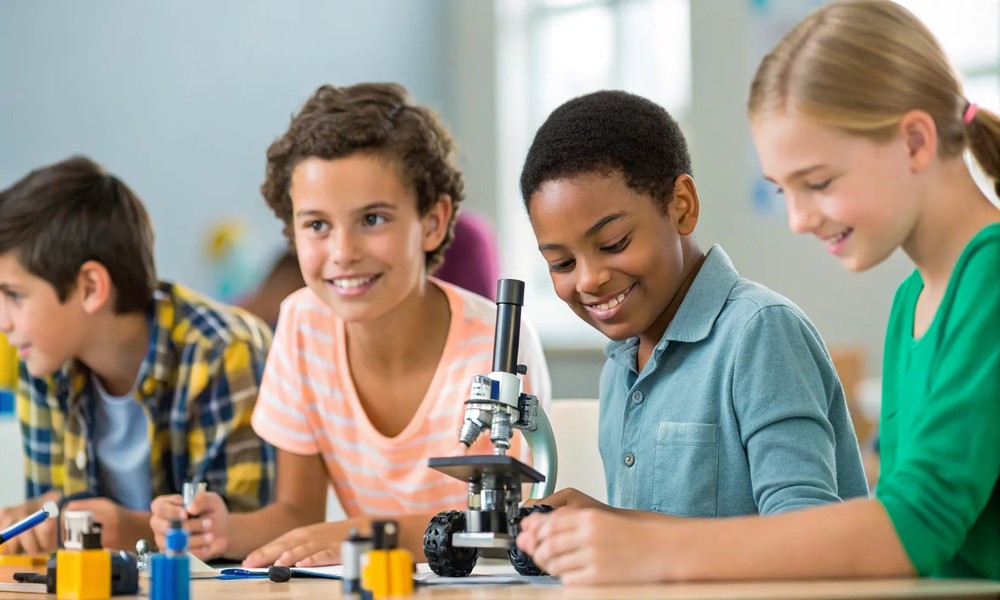
The traditional middle school classroom is quiet no longer. Now, students are building bridges and launching rockets. Educational innovators like Mission.io are completely reshaping how children learn. This transformation replaces dull lectures with vibrant discovery. Six graders do not just read text. Instead, they touch materials and create solutions. But this change is not merely about fun entertainment. It represents a deep shift in core pedagogical philosophy. Today, bright young minds learn complex science by doing physical work.
Tangible Learning Sparking Curiosity
Sometimes, abstract textbooks fail to inspire deep student curiosity. Young learners need concrete things to touch and see. That is why teachers introduce interactive projects every single day. Mission.io helps educators design these active learning experiences seamlessly. Students build motorized cars using simple wooden blocks. Then, they measure the speed across different floor surfaces. Now, difficult laws of motion make sense immediately. You see excitement in their eyes during every experiment. The classroom buzzes with loud voices and genuine laughter.
Critical Thinking Replacing Rote Memorization
Standard memorization does not prepare children for future careers. Six graders must learn how to solve real problems. Therefore, instructors present open-ended challenges with multiple answers. The students look at available resources creatively. They choose sixth grade STEM activities to challenge their minds. For example, building cardboard towers tests structural integrity limits. Sometimes, the fragile structures collapse during the final testing. But failure teaches better lessons than perfect initial success. You learn how to rebuild stronger frameworks every time.
Preparing Future Leaders for Global Challenges
Our world faces massive environmental and technical hurdles. Today’s youth will eventually discover the necessary solutions. Consequently, early exposure to practical engineering matters immensely. Students design miniature solar ovens using recycled aluminum foil. They melt marshmallows to study clean thermal energy conversion. This simple experiment connects classroom lessons to global issues. The young scientists realize their potential to change things. Now, education feels deeply relevant to their personal lives. You witness the growth of tomorrow’s great inventors.
Conclusion
The transformation of the modern classroom continues to accelerate. Hands-on exploration proves far superior to passive listening. Students absorb knowledge deeply when their hands are moving. They develop resilience by fixing their own creative mistakes. Now, school prepares children for an unpredictable future landscape. The journey of discovery begins with one simple project. Sixth grade is the perfect time for this spark.
FAQ
- Can STEM Projects Survive Messy Classroom Chaos?
Yes, structured activities keep students focused and creatively engaged.
- Why Do Cardboard Towers Collapse During Science Lessons?
Failures teach resilience, stronger planning, and smarter rebuilding techniques.
- Do Rockets and Marshmallows Really Improve Academic Learning?
Hands-on experiments make scientific concepts easier and deeply memorable.
- Can Shy Students Become Leaders Through STEM Teamwork?
Group challenges encourage communication, confidence, and collaborative problem-solving abilities.
- Why Are Sixth Graders Suddenly Obsessed with Building Experiments?
Interactive projects replace boredom with curiosity, excitement, and active discovery.
